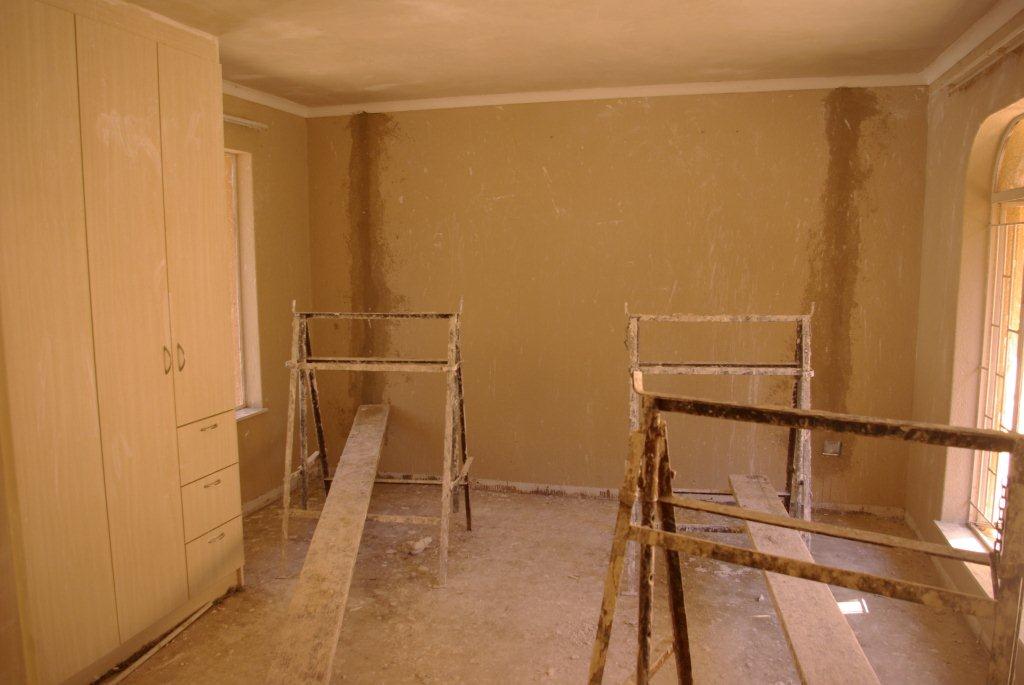
Poor project management. House renovation, the cupboards have already been installed, walls are painted, then the ceiling is Rhinolited, and two plug points are chased.
What is the most petrifying problem facing you when you build a new house or take on a large renovation project? The waste of your money and time? The broken trust of your contractor when things eventually start going wrong? The stress that it puts onto you and your family? Or your reputation when managing a project for your company?
That helpless feeling when you realise you are working with incompetency – does not matter how competent your builder is; when things start going wrong, what can he do to fix it? He is not building your house, it’s his workers, and they are mostly not capable of making the decisions that will positively benefit your builder; or you for that matter. They will be happier sitting under a tree than laying bricks.
No, the biggest problem is having your dream shattered: you’ve spent so much time discussing your ideas, dreaming of how it will be when finished, getting excited about the whole idea. And when the big day arrive – all the approvals have been made, the budgets are set – and the first shovel hits the ground to lay the foundation. You can hardly wait! And the project plan says five months from now you will be in your new home!
But, this hardly ever happens.
The purpose of this article is to give you a new way of approach to building or renovating. It might seem like a lot to take in, but will be worth your while. At the end of the day it is you who wants to build, and it is you who needs to live in the new house. And it is your money.
Building a new house usually works like this: You start planning the project with your architect. Over the next few weeks you refine the plans, bringing in some new ideas, taking out some old ones, paging through magazines looking for the ultimate way of utilising different areas in the design. Eventually you submit your plans for approval.
Then you start looking for a builder. The architect or a friend of yours might suggest one. You ask for quotes, choose the one that falls inside your framework of trustworthiness, price, and reference, and then you start building.
The builder has quoted you on everything; from laying the foundation right down to the last lick of paint. He might have included things like tiling, putting in cornices and skirting, window frames, plumbing, and all the small things that builders should be able to do. Does this still sound familiar? You see; why shouldn’t he be able to do it? Most of these things are easy when you break it down into its small components, not so?
Absolutely right they are! But have you stopped to consider the implications when something goes wrong with one of these things?
Your builder will probably not be on site all the time, and why should he? He’s busy running an extremely difficult business. He needs to make sales, sort out accounting problems, look at the new website that needs to go up, have meetings with old clients and new prospects, draw up quotes, and every now and then, get back to your site to see if the foreman and the workers are doing their jobs. It is not his job to lay the bricks.
So he trusts that his team of bricklayers will be able to anticipate the laying of the pipes for the plumbing and electricity, put in the cornices, and paint the house. And why shouldn’t they be able to? They have done it before… we will not know to what level of success, or how many times they had to redo it, but they have done it before.
So the project management that you were promised falls by the wayside, mistakes start occurring because everything needs to happen at the same time, and before you know it, you are sitting at month eight already and the walls are not even painted yet. The workers are getting bored with what they are busy doing – not that they really cared in the first place – they are getting tired of being screamed at, more and more mistakes are being made, and you are the one fitting the final bill.
A building project usually works like this: the foundation gets laid, then the walls goes up. While the walls are going up, some of them are getting plastered because progress seems to be so good with the building. Before the plaster is finished, the roof starts going up, and the areas that was plastered a couple of days ago gets their first coat of plaster primer (hopefully not, but very possibly, contractors PVA) without taking into account that the walls are still busy curing, the plaster should not have been up yet, but now that it is, it should also still be curing, and not getting painted over.
Progress seems to be excellent! It has not even been two months and the roof is already going up! And then someone realises that the plug points and plumbing needs to be laid, so the chasing begins. Through the plaster that was not properly cured, but that already has been primered. And things start to go south from here…
I’d like to suggest to you a new way of thinking about building, because at the end of the day it is your responsibility, whether you like it or not, to get a nice house, and to live in it. How you approach the project at the beginning will determine the result that you get:
Builders should lay bricks, Plasterers should plaster, Roofing guys should put roofs on, Plumbers do plumbing, Electricians do the electricity, Painters paint, Kitchen guys install kitchens, Finishing specialists does special finishes, etc.The builder should not do all of this! So don’t hire him for all of this! If it fails, it will be your fault, but you would want to blame him! He was trying to make a sale, and you were trying to save money and make it easy for yourself! Don’t!
The construction process should go like this:
- The builder lays the foundation and starts building the walls. With him the electrician and plumber plans and implements their pipes so that by the time the walls are up, the plug boxes are in and so too the plumbing. The window and door guy must also be involved here. Make sure that the bricklayers are not also the window installers; your windows will be skew.
- Then the builder stops and the roofing guy comes in.
- Once the roof is up, the ceiling guy comes in.
- When the ceilings are done and Rhinolited, the plasterer comes in.
- When the plastering is done, your choice of finishing work can start. At this stage there should still not be any screed on the floors, just bare concrete. There should be no cornices or any other finish inside or outside the house, not even plaster primer. This effectively gives you flexibility in choosing finishes. (Please note here that the finishing should not be an afterthought. If the building project was done wrong, the finish will be wrong. Also note that the finishing project can easily cost the same as the building project, so don’t fool yourself: your structure is you’re your structure, you finish is your home)
Each stage of the construction process should involve different people. This way you can actually hold individuals responsible for smaller aspects of the project, thereby eliminating a lot of confusion and finger-pointing.
When putting this suggestion onto paper, it will appear to take a lot longer, and might appear to cost a lot more, but let’s just quickly think about it: your builder’s initial estimation of five months will be over shot in any case. So too will the budget because of the mistakes that has been made.
If you start taking control of the major steps of your building project and get specialists in to micro-manage their projects, your chances of success will be much, much higher.
And please, do not work from the assumption that the finish will cover the building’s imperfections. Finishes are thin, decorative and protective products, not quick fixes.
About the author: Michael Pretorius is an experienced interior designer and owner of Creative Touches interiors. For more information you can visit www.creativetouches.co.za or call him directly on 082-392-3336


Fantastic line up. We’ll be linking to this fantastic post on our website. Sustain the nice producing.
Thanks for the great Post – very COOL!!!
Easy to understand,I like it!
Hi there! I could have sworn I’ve been to this web site prior to but right after searching by means of a number of the article I recognized it is new to me. Anyways, I’m surely content I discovered it and I’ll be book-marking and checking again regularly!